Why most personal sites don’t work
Designer portfolios converge on the same shape. A grid of project tiles, a short bio, maybe a contact form. They behave like cover letters that hope someone will read them. Most of them go unread.
The reason isn’t that the work is bad. It’s that the format doesn’t match how a person actually wants to learn about a designer. Real questions are specific: have you worked in healthcare? do you understand engineering teams? what do you think about design systems for early-stage startups? A grid of tiles can’t answer those. It can only invite a stranger to do the work of figuring it out.
What I built instead
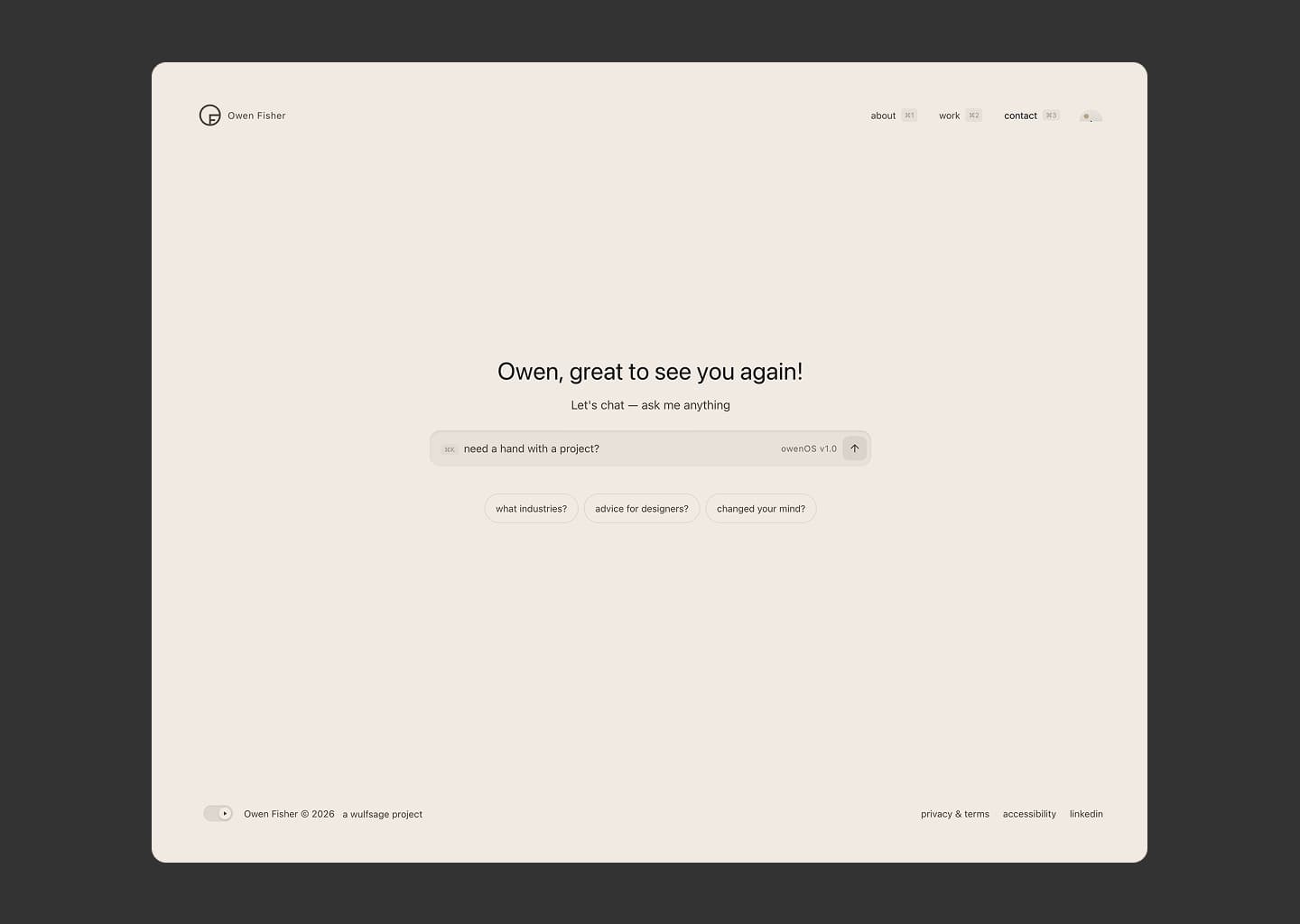
owenfisher.co is a personal site with an AI trained on my work, my thinking, and my process. You arrive on the page, and instead of a tile grid, there’s a question prompt. You ask it anything — what I think about a particular framework, how I’d approach a specific problem, what kind of clients I work best with — and you get a real answer.
The AI is grounded in everything I’ve written, designed, and shipped. It’s not a generic chatbot wearing my face. It’s a faithful interface to a specific body of work, with the limits of that body of work as its limits.
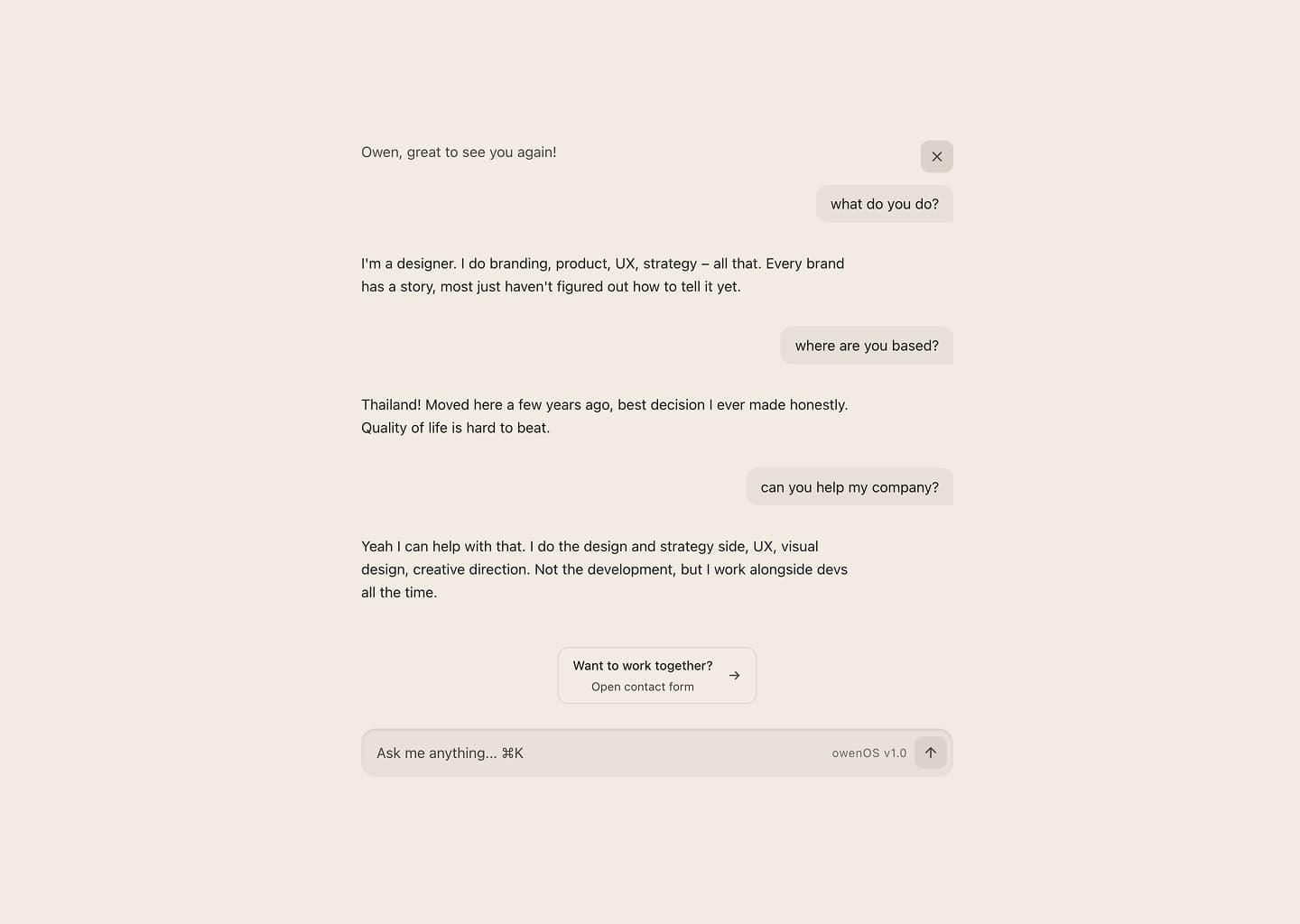
The point of the AI isn’t novelty. It’s solving a specific design problem: matching the medium to the question.
What it does that a static site can’t
Answers actual questions
Someone arriving with a specific question gets a specific answer. They don’t have to filter through projects looking for the relevant ones. They don’t have to extrapolate from a bio. They ask, and the response is calibrated to their actual situation.
Sets the tone immediately
A founder reading the site can tell within the first exchange whether we’re going to be a fit. The AI talks the way I do — same voice, same instincts, same willingness to disagree when something doesn’t land. That’s a more honest preview than any portfolio grid.
Cuts the path to action
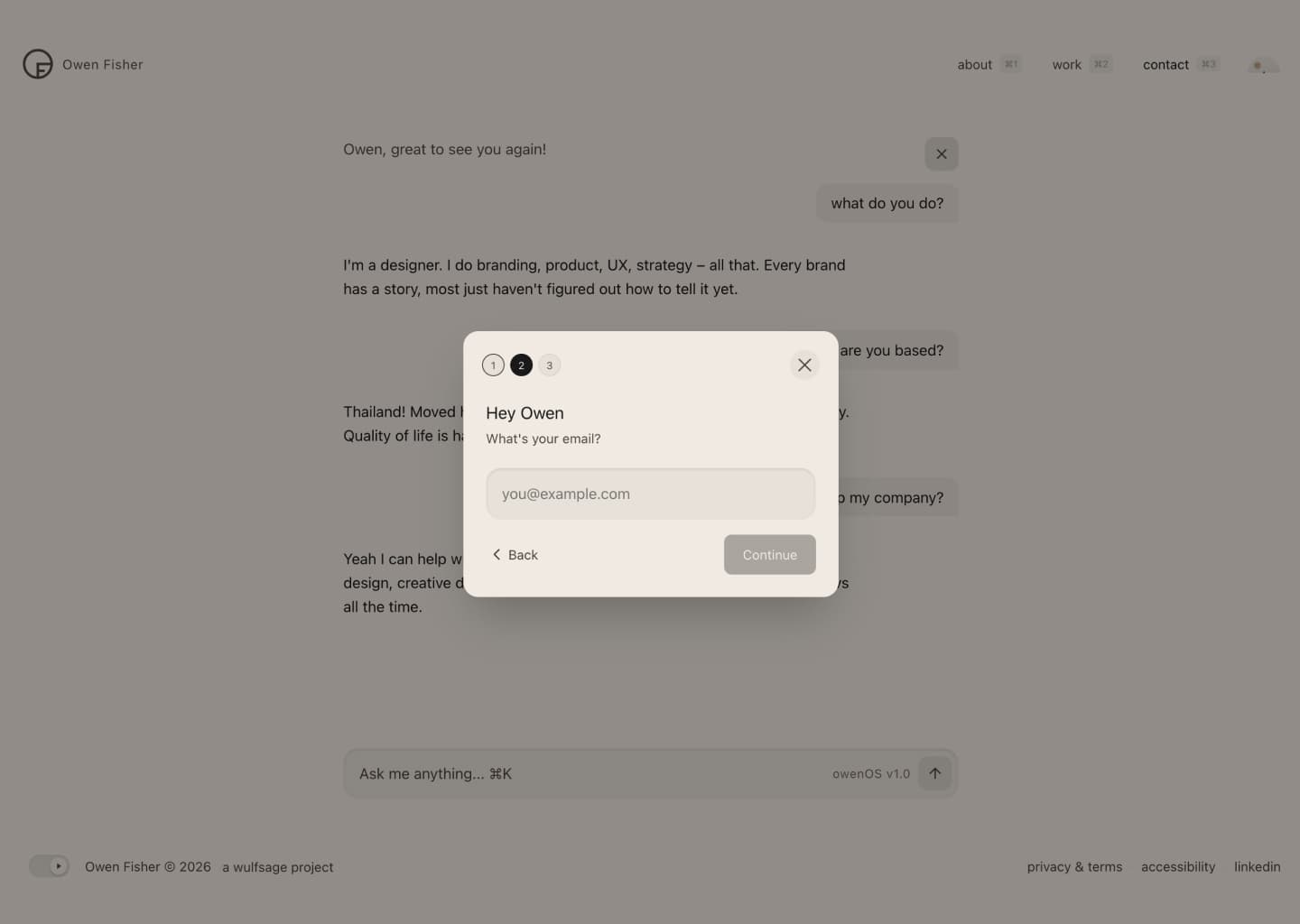
For someone who’s already thinking about working with me, the AI shortens the gap between curiosity and contact. They can ask the questions they would have asked on a call before deciding whether to book the call. That filters in the right people and out the wrong ones.
What it taught me about design and AI
Three things that have carried into client work:
- The medium IS the message in AI products. Adding a chatbot to a regular site is a feature. Replacing the site with a conversational interface is a different argument. The first is incremental; the second is editorial.
- Constraints are the ground truth that keeps AI useful. An AI grounded in a specific body of work is reliable. An AI trained on the whole internet is a fortune teller. The narrower the source, the sharper the answer.
- Personality has to come from the actual person. A voice trained on placeholder marketing copy sounds like a chatbot. A voice trained on real writing sounds like a person. The difference is audible in the first sentence.
How it relates to the studio
wulfsage.com is the studio surface. owenfisher.co is the personal one. They’re deliberately different shapes serving different jobs:
- wulfsage.com — the studio offer, the case studies, the methodology. Brand-voice. Where a founder decides whether to book a call.
- owenfisher.co — the personal practice. Owen-voice. Where someone goes to figure out whether they actually want to work with me as a person before committing to a call.
Both surfaces share a sameAs entry in the studio’s schema, so AI engines treat them as one entity with two facets. That’s the point — the studio sells the offer; the personal site does the trust building.
Status
Live at owenfisher.co. Maintained alongside the studio. The AI gets updated when the body of work it represents grows.