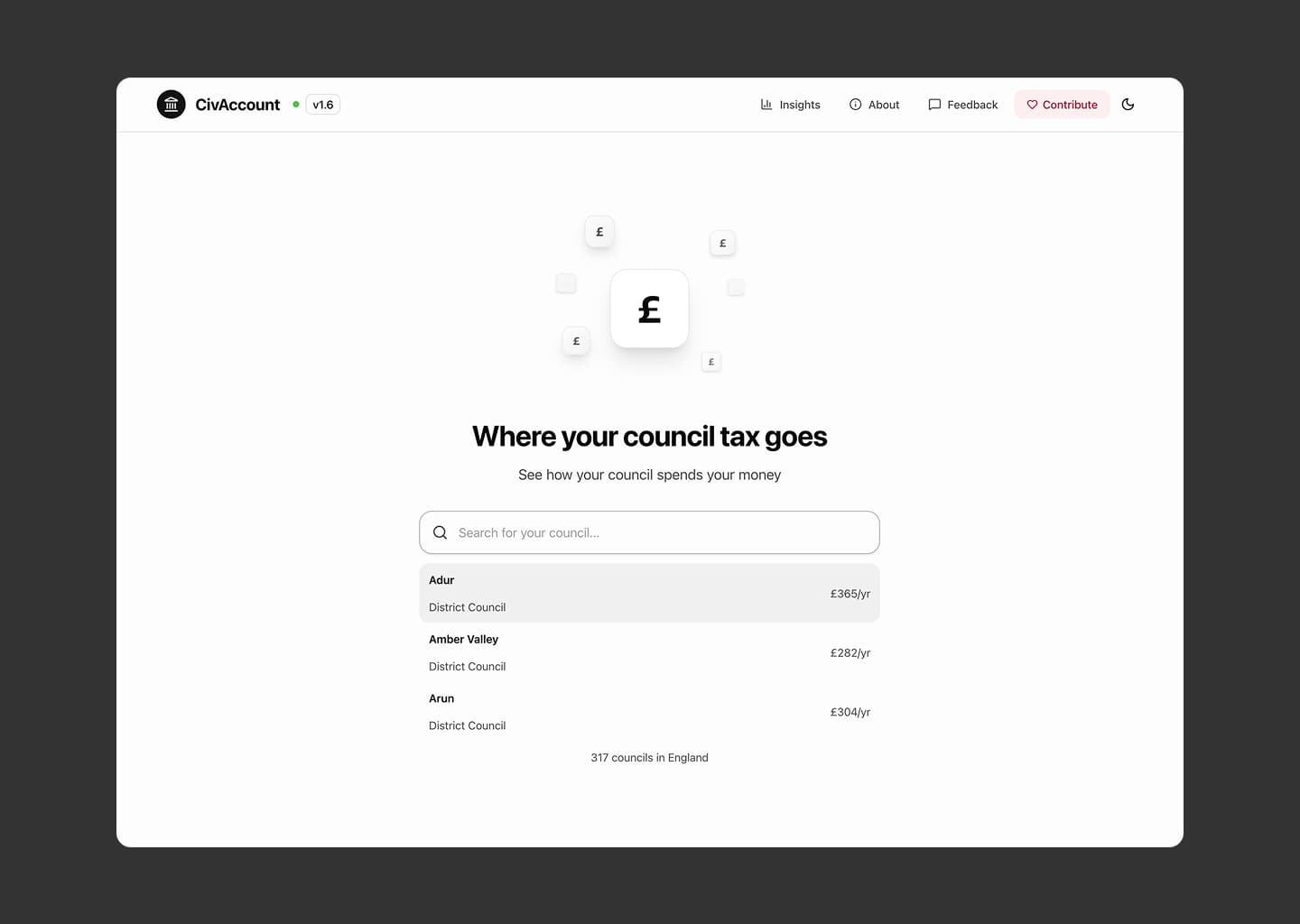
The premise
Every UK local council publishes financial data — budgets, council tax breakdowns, what they spend on what services. The data is technically public. Practically, it’s buried.
Each council has a different website. Each website has a different way of presenting the same information. Some publish PDFs. Some publish XLSX spreadsheets that crash on mobile. Some publish HTML tables with no totals. None of them are readable in the way you’d want to read your own household budget.
The result is a layer of opacity around how local government spends money. Citizens can’t see what their council tax actually pays for. Local journalists can’t compare across councils. Anyone wanting to engage with their council’s spending has to first do an hour of data archaeology.
What I wanted to prove
CivAccount wasn’t built as a product play. It was built to prove a specific point: when public data is genuinely accessible — not available, accessible — it changes who engages with it.
The bar I set was simple. A parent should be able to check what their council tax pays for over morning coffee. No downloads. No jargon. No spreadsheet skills required. If a five-second visit doesn’t produce a five-second answer, the project failed.
The accessibility gap in public data isn’t a technology problem. It’s a design problem dressed up as a technology problem.
The work
One canonical layout, every council
Every council page on CivAccount uses the same structure. Headline budget number first. Where the money comes from second. Where it goes third. A five-year trend line so you can see whether your bill has grown faster or slower than national averages. Service-by-service breakdown that you can navigate from the top of the page or from a band selector.
The same shape across hundreds of councils means once a citizen has read one, they’ve read all of them. No new mental model required.
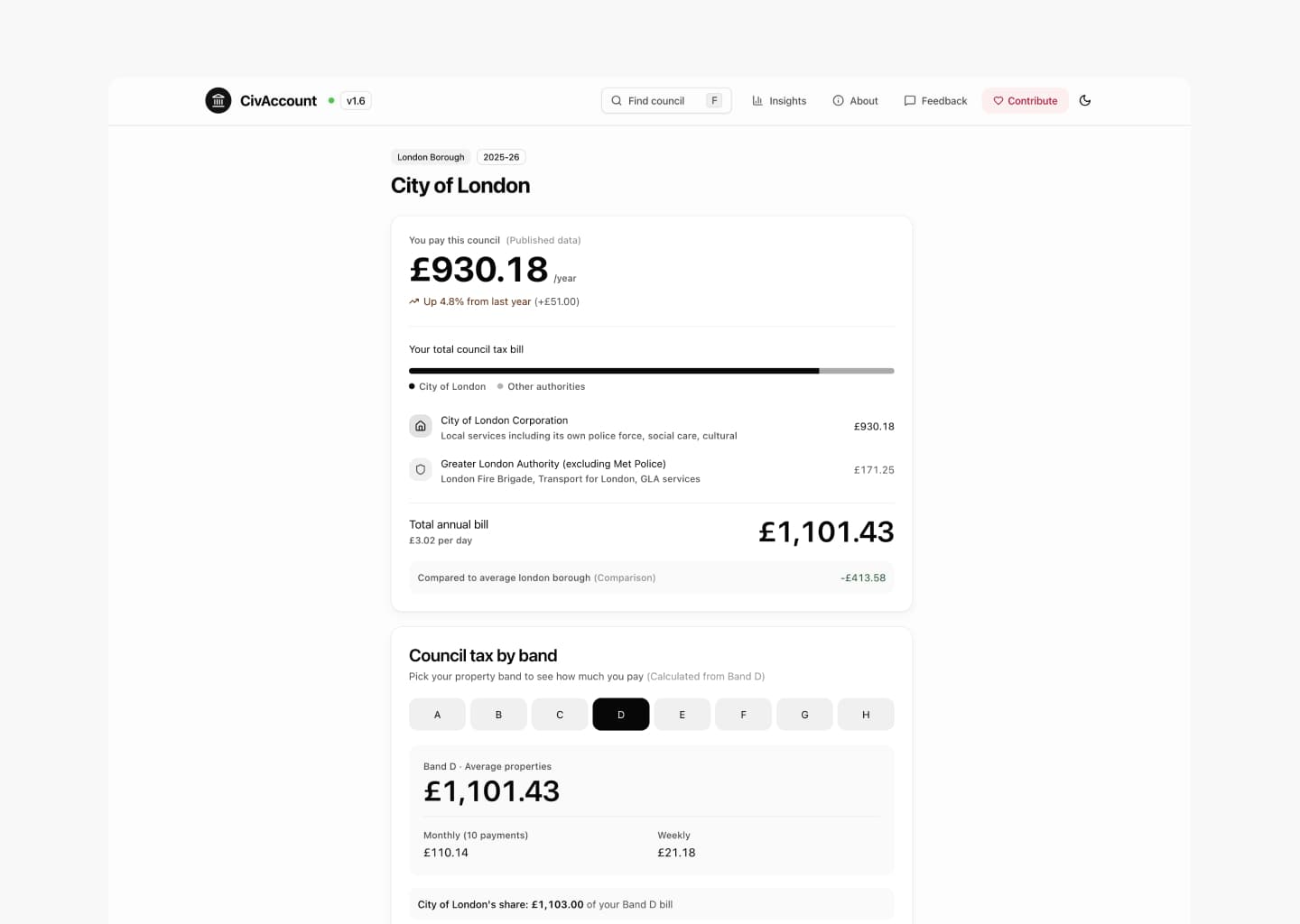
Mobile-first because the user is in motion
The original government data is almost always served as desktop-only PDFs or Excel files. CivAccount is mobile-first because the actual moment someone wants to know what their council spent on potholes happens at the kitchen table or on a bus, not at a desk.
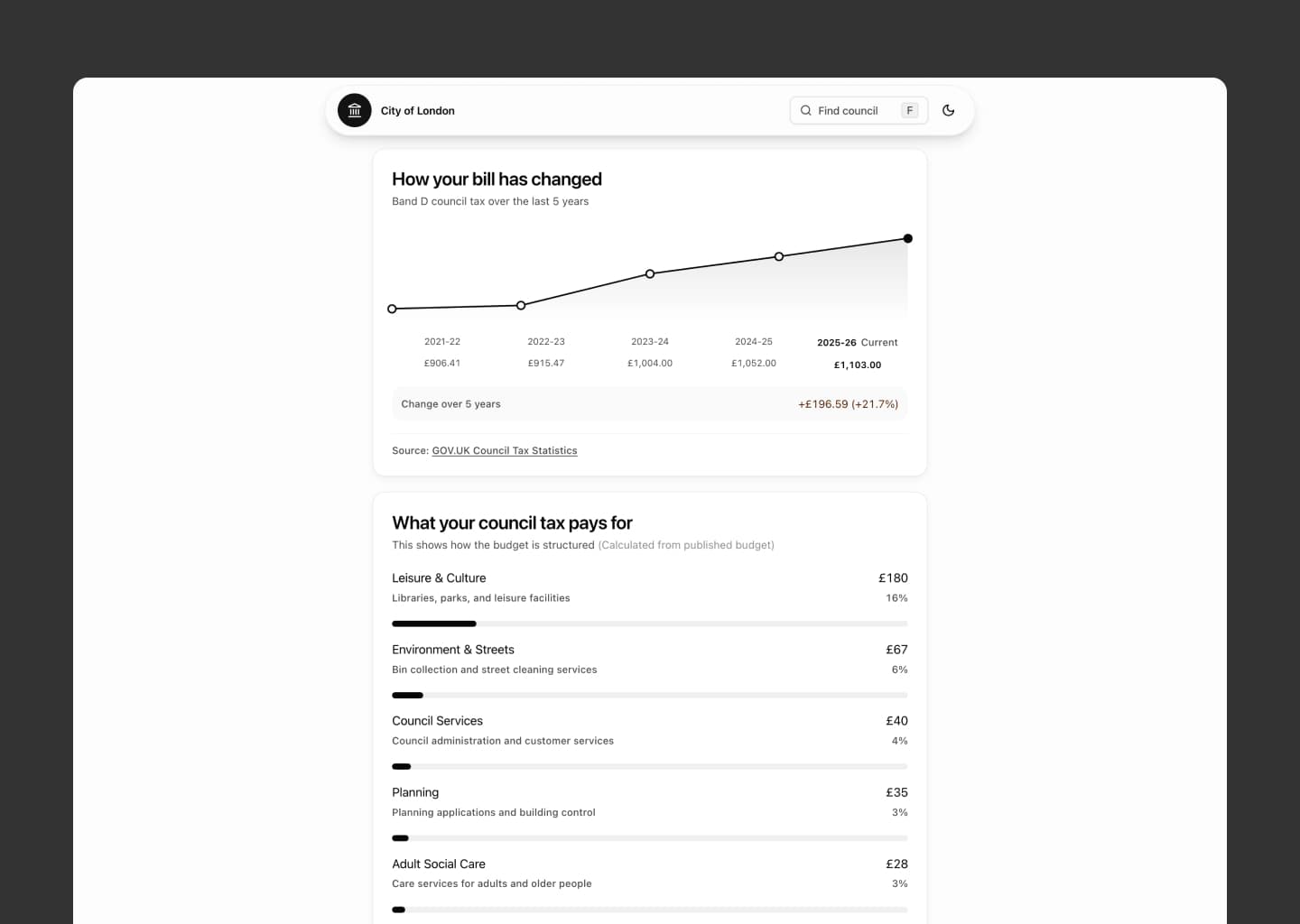
Plain language by default
Council budget documents use phrases like “net cost of services chargeable to the general fund”. CivAccount translates everything to plain English. Where the original term matters legally, it’s included as a hover note rather than the headline.
Why this matters for the studio’s work
CivAccount isn’t client work. It’s a public expression of how the studio thinks about design. Three principles in particular:
- Findability is a design responsibility, not an afterthought. The same data “available” on a council website was functionally invisible until it was redesigned.
- Plain language outperforms expert language when the audience is wider than experts. Government writing is a perfect test case because the original is so jargon-dense.
- One pattern repeated cleanly beats clever variation. CivAccount’s power comes from sameness across councils, not from a new layout per council.
Those three principles also show up in client work — in ProblemShared’s product UI, in ATOL’s site structure. The project work and the personal project share a worldview about what design is for.
Status
Live at civaccount.com. Built and maintained by Owen as a personal project. Not monetised. Built because the gap was annoying and the question of how-public-is-public-data was worth answering by demonstration.